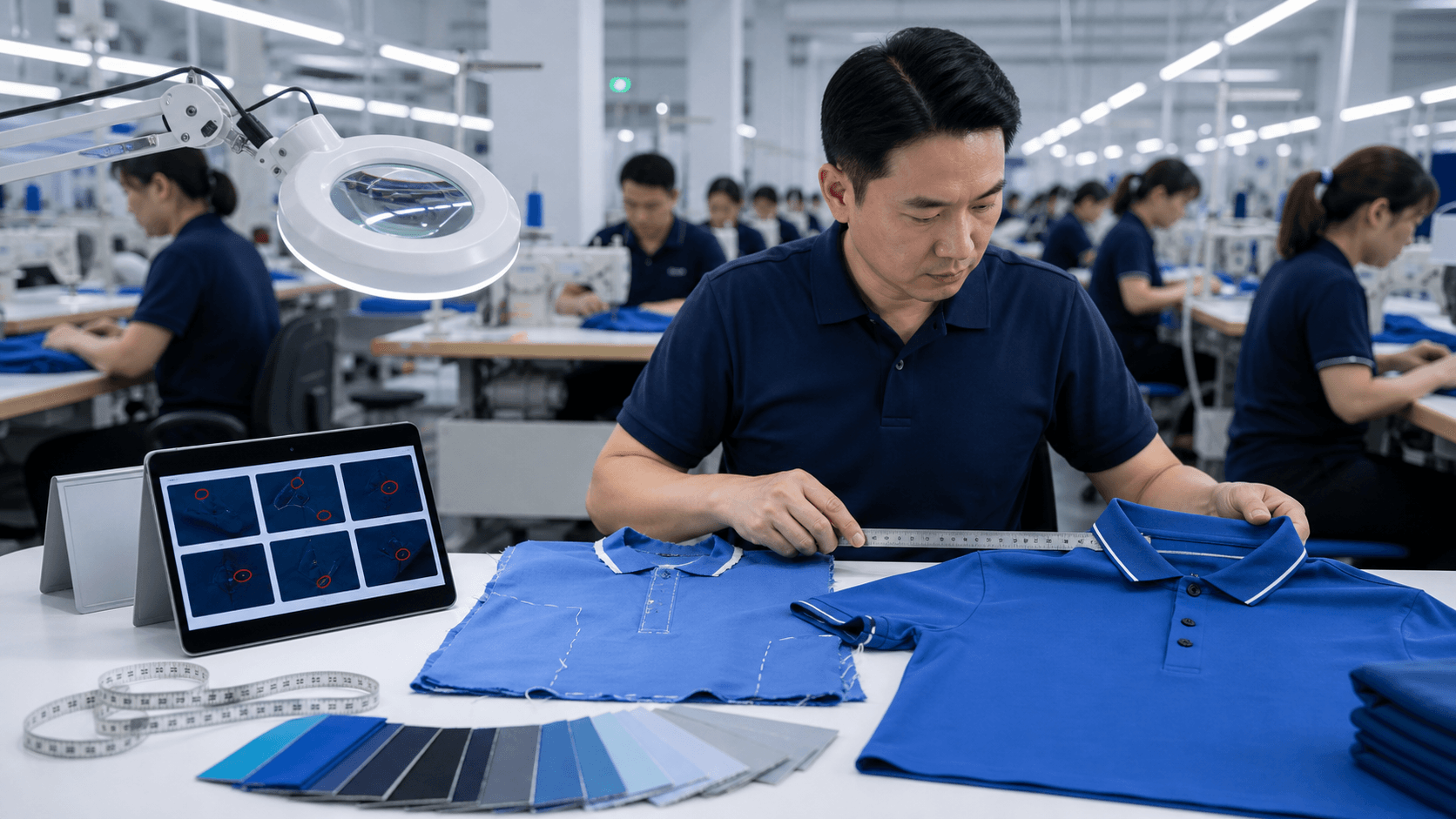
# Why Final Audits Miss Defects That Begin Earlier in Production
Final Audit Limitations
A final audit confirms whether a finished shipment meets your buyer's acceptance criteria. But when an ISO 2859-1 (AQL) audit takes place, bedding sets, linens, or terry towels have already been cut, stitched, finished, polybagged, and packed into master cartons. At that stage, discovering a repeated defect tells you that an issue exists—not where, when, or why it began.
By the time a defect surfaces in a final random sample, your team is forced to trace back through days of production, multiple shift handovers, varying fabric rolls, and machine adjustments. QualityIris provides self-serve, digital [home textile inspection software](https://qualityiris.com/lp/home-textile-inspection-software) that connects active inline floor checks with final-audit records, stopping recurring defects while production lines are still running.
---
Symptoms Versus Root Causes
### TL;DR: Final Audits Measure Symptoms, Not Root Causes
An ISO 2859-1 final audit delivers a statistical pass/fail verdict for shipment release, but it cannot stabilize upstream manufacturing. Capturing live inline data gives your QA team the context needed to trace defects to their true source:
- **Final Audits:** Determine lot acceptance or rejection against agreed AQL thresholds.
- **Inline Inspections:** Catch sewing, tension, weaving, and assembly flaws during live production.
- **Point-of-Measure (POM) Tracking:** Reveals gradual dimensional drift before fabric is cut and hemmed in bulk.
- **Iris AI-Powered CAP:** Generates structured Corrective Action Plans directly on the sewing floor where adjustments can actually be made.
When inspection records are trapped on paper clipboards and isolated spreadsheets, correlating inline issues with final failures is nearly impossible. QualityIris unites inline verification, tech-pack measurements, and final audit results in a single digital platform.
---
Real-Time Inline Inspection
## 1. Inline Checks Expose Defects at the Needle Point
Catching a defect during live sewing or finishing costs a fraction of fixing packed cartons. With mobile-first digital forms that work both online and offline in remote sewing sheds, inspectors document findings in real time.
### For Bedding & Flat Goods:
Inspectors track critical construction parameters using dedicated [bedding quality inspection software](https://qualityiris.com/lp/bedding-quality-inspection-software):
- Seam puckering, skipped stitches, and thread tension balance
- Envelope closure alignment, zipper insertion, and buttonhole reinforcement
- Fitted sheet corner pocket depth and elastic band stretch-and-recovery
- Dye-lot shade consistency across pillowcases, flat sheets, and duvet covers within the same set
### For Terry Towels & Bath Linens:
Using specialized [towel quality inspection software](https://qualityiris.com/lp/towel-quality-inspection-software), inspectors capture:
- Pulled, loose, or uneven terry loops and pile density variations
- Dobby border bowing, jacquard distortion, and selvedge frays
- Dry piece weight deviations against target GSM specifications
- Differential shrinkage between the terry body and decorative flat borders
With QualityIris, inspectors pair every defect with high-resolution photo evidence (via direct camera capture or gallery upload), precise defect classifications, and affected quantities. This ensures factory floor supervisors see exactly what went wrong within minutes—not days later.
---
Monitoring Measurement Drift
## 2. Measurement Trends Reveal Drift Before Goods Are Packed
Measurement drift is the silent cause behind many failed final audits. A fitted sheet pocket depth, pillowcase opening, or bath sheet length rarely jumps out of tolerance suddenly; it drifts gradually as fabric rolls relax, cutting blades dull, or sewing guides slip.
Final AQL audits flag out-of-tolerance units, but they don't show when the variance started. QualityIris logs measurements directly against imported buyer tech packs:
- **Unit & Tolerance Flexibility:** Supports inches, fractions, and centimeters with exact absolute or percentage tolerances.
- **Visual Drift Warnings:** Highlights when dimensions begin trending toward upper or lower tolerance limits, enabling floor managers to recalibrate machines before an entire batch breaches specs.
- **Multi-Size Matrices:** Tracks flat goods and graded apparel POMs across all sizes in a single clear table.
---
End-to-End Defect Traceability
## 3. Connect Bedding and Towel Findings Across Production
Bedding and terry towels carry distinct quality risks, but both require end-to-end traceability across lots:
- **Cross-Stage Visibility:** Compare inline defect histories directly against final AQL sample results.
- **Repeat Defect Identification:** Automatically flag recurring supplier flaws across multiple POs and production lines.
- **Iris AI-Assisted Corrective Action Plans (CAP):** In QualityIris, CAPs belong to inline inspections where the mill can still intervene. **Iris AI** analyzes logged defect patterns, photos, and root causes to compose clear, actionable corrective steps for floor managers to sign and execute immediately.
---
Peak-Season Quality Control
## 4. Build Earlier Control Into Peak-Season Production
Peak manufacturing windows bring intense shipping pressure, holiday replenishment deadlines, and high volume. Relying solely on final audits during peak volume creates an all-or-nothing bottleneck at the loading dock.
Combining disciplined inline controls, live POM measurement tracking, and automated ISO 2859-1 final audits gives your team the agility to protect buyer delivery dates without compromising on quality standards.
---
Start Improving Production Control
## Trace Defects Back to Their Source Today
Standardize your inspection workflows, catch dimensional drift early, and empower your floor inspectors with modern digital tools:
- **[Explore Home Textile Inspection Software](https://qualityiris.com/lp/home-textile-inspection-software)** to see how QualityIris supports bedding, linens, and towel manufacturers.
- **[Start your 14-day free trial](https://qualityiris.com/signup)** with instant access—no credit card required.
- **[Try the interactive demo](https://qualityiris.com/demo)** to test real-time inline checks, ISO sampling calculators, and Iris AI workflows.